 FAMILY
Every subject.
Their own pace.
Learning that's fun.
WZRD finds exactly where each of your children is at in maths, reading, spelling and writing, then gives them the next step every day, in a world they love. Like a language app, but for every subject at school.

Know where they're at. Give them the next step. Watch them grow.

A ten-minute check
A friendly quest finds each child's level in every subject, skill by skill. No marks out of 100, no stress: just where they are and what comes next.

At their own pace
Each day brings a mix made for that child, and they can go as far as they like: the next step in maths, a story at their reading level, words they actually got wrong. Streaks and stars keep it fun.

You see it all
One family page shows every child: what they've mastered, what they're working on, and one thing you can do at the dinner table this week.
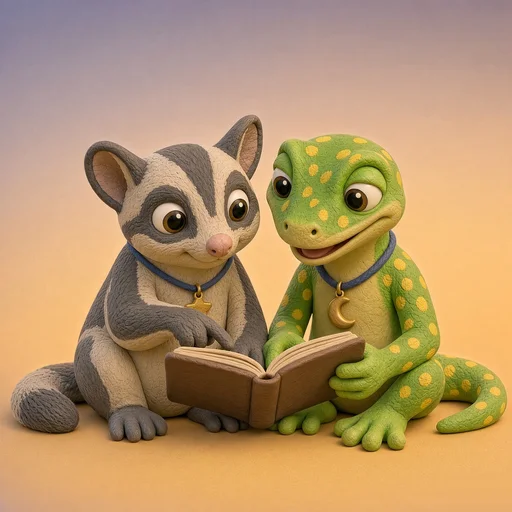
Two friends beside every question
Ziggy, a sugar glider, cheers on first tries and hard questions. Stix, a gecko, helps after a wrong answer, with the question's own hint, a step at a time. No chat, no AI: just two friends who never give up.
One page for the whole family
Every child, every subject, on the same three steps their teachers use: not yet, secure and extending. Measured against what's expected for their year right now, and always with the very next step.
- Levels for maths, reading, spelling and writing, updated as they practise
- The skill that matters most next, in plain English
- A weekly email to you, never to your children
- If their school uses WZRD, practice follows what their class is learning (only when the school switches it on)

Next step: fractions of a collection (a half of 12, a quarter of 20).

Try at dinner: ask Leo to argue for his favourite team in three reasons. He's working on persuasive writing.
Not the next worksheet in a book. Their next step.
Make a test in two taps, pitched exactly where your child is. WZRD marks it, explains what went wrong, and folds it into tomorrow's practice.

Before-the-test check
A short check on this term's topics, so nothing is a surprise.

NAPLAN-style practice
Years 3, 5, 7 and 9: the question styles and the writing task, at a calm pace, with feedback on every answer.

Facts to fluency
Times tables and number facts, a minute a day, until they're automatic.

Their own spelling list
Built from the words they actually get wrong, then checked again a week later.
Holidays that get them ready for next term
Each holiday, WZRD builds a pack for each child: a little of what they need to secure, and a head start on what their year level learns next. Screens or paper, twenty minutes a day, with plenty of days off.
Five short sessions on the skills from last term that aren't secure yet.
A reading challenge at their level and a family maths game. That's it.
The first ideas from next term's units, so day one feels familiar.
A friendly check, a certificate, and a note for you on how it went.
Ready, Set, School
Six months of ten-minute play sessions that get your child ready for their first year of school: early numbers, sounds and letters, holding a pencil, talking and listening, and the everyday independence Prep teachers hope for. Matched to Victoria's early years framework and what children meet in Foundation, so day one feels familiar. And when they start school, WZRD already knows where they're at.
Numbers and counting
Counting to 20, one number for each thing, knowing 0 to 10 on sight, more and less, shapes and patterns.
Sounds and letters
Hearing rhymes and first sounds, the first letter sounds (s, a, t, p, i, n), and spotting their own name.
Pencil and hands
A comfortable pencil grip, lines and circles, writing their name, cutting, threading and drawing.

Talking and listening
Following two-step instructions, retelling a story, new words every week, and listening to books.

Me and others
Taking turns, naming feelings, asking for help, and saying a confident goodbye at the gate.
Getting myself ready
Opening a lunchbox, shoes on, bag packed, using the toilet alone, and knowing their own things.
Counting games, rhyme time, playdough and drawing. Ten minutes, no worksheets.
First letter sounds, numbers to 10, writing their name, two-step instructions.
A pretend school morning at home: bag, lunchbox, listening on the mat, packing up.
Visit the school, try the uniform, read a starting-school story, and a readiness check for you.
What a Ready, Set, School day looks like
- Count the steps: count the stairs together, then jump the last three
- Sound hunt: find three things in the kitchen that start with "s"
- Name practice: trace their name in rice on a tray
- Story time: tonight's book, with one question about the ending
Each session is guided step by step for the parent, and WZRD moves at your child's pace.
From four to sixteen. Ready, Set, School leads straight into WZRD School and WZRD Family in primary, then Next Stop: High School. One record of where your child is at, all the way through.
Next Stop: High School
Eight short modules that take the worry out of the move to Year 7, and get your child ready for the work: what's different, staying organised, every subject they'll meet, how subject choices work later on, study skills, friendships and independence, and a Year 7 readiness check in maths and English.
1. What's different
Periods and bells, a teacher for each subject, moving rooms, lockers and a much bigger school.
2. Getting organised
Reading a timetable, using a planner, packing by the day, and a homework routine that sticks.
3. The subjects of Year 7
English, maths, science, humanities, a language, health and PE, the arts and technologies: what each is like.
4. Choosing subjects later
How electives work in Years 9 and 10, and how they lead to the senior years (VCE and VCE Vocational Major in Victoria).
5. Study skills
Taking notes, revising for tests, planning an assignment, and what to do when you're stuck.
6. Friends and independence
Making new friends, catching public transport, phones and online life, and where to get help.
7. Ready in maths and English
A check on the Year 6 skills Year 7 builds on, then practice on anything that isn't secure yet.
8. What could I be?
Strengths from their own work turned into careers worth exploring, and the subjects that keep those doors open.
Pick up to three things you're good at or love
In WZRD Family this comes from your child's own work: their levels, their best pieces, what they choose to practise. Here, pick a few to see how it works.

Magpie Makers
Magpies collect shiny things and take them home. Artists do the same with ideas. Ten sessions where children collect what they love, learn from their heroes, cut things up and put them back together in new ways, make a little every day, and show their work to the world. Paper, scissors, glue and the recycling bin. Inspired by the ideas of author and artist Austin Kleon.
1. Be a magpie
A Magpie Box of things they love, and why each one made the cut.
2. Art family tree
Their heroes, their heroes' heroes, and them as the newest branch.
3. Copy to learn
Copy a master square by square, change one thing, and always say who it came from.
4. Blackout poems
Find the poem hiding in a page with a thick black marker.
5. Cut it up
Word tiles and shape tiles to cut, shuffle and remix into poems and creatures.
6. Hands first
Fold-and-draw creatures, torn paper and recycling builds. No screens at all.
7. A little every day
Ten days, ten tiny makes, ten minutes each. Watch them add up.
8. Make a zine
A tiny eight-page book from one sheet of paper. Published!
9. Show your work
The start, the messy middle and the end, plus a card to teach someone a trick.
10. The exhibition
Gallery labels, kind feedback cards, an opening night and a keep-going list.
The magpie rules
- Borrow from lots of people, not just one
- Always say where an idea came from
- Change it until it becomes yours
- Make it with your hands first
- Share how you made it, not just the finished thing
Every session has a step-by-step guide for you and a printable sheet to cut, fold or draw on. In WZRD Family, finished pieces go into your child's own gallery.
Before you start: play needs space, time and materials, all three at once. Read the play guide.
Austin Kleon's books (Steal Like an Artist, Show Your Work! and Keep Going) are wonderful to share with older children. WZRD isn't connected with him; the sessions and sheets are our own.
Inner Coach: the voice in your head
How we talk to ourselves is often much harsher than how we'd ever talk to a friend. In eight short sessions, children notice that voice, turn their inner critic into a silly character so it feels smaller, and invent a kind inner coach: an imaginary friend, on purpose. Then they practise talking to themselves the way they'd talk to someone they love.
1. Everyone has a voice inside
Noticing it, and learning that grown-ups and sports stars have one too.
2. Meet your inner critic
Draw it, give it a silly name. Grumble, Mr Nope, the Moaning Moth.
3. Would you say that to a friend?
The friend test: turning the critic's lines into what a friend would say.
4. Make your inner coach
A kind character who lives in your pocket, with three catchphrases.
5. Talk to yourself by name
"Okay, Mia, one step at a time." And the hero trick.
6. The power of yet
"I can't do it yet", and a mistake museum of useful mistakes.
7. When the critic gets loud
A volume dial and five tools: name it, breathe, move, talk, ask your coach.
8. Kind voice, out loud
A compliments circle, and a letter to themselves to open in a year.
Built on simple, well-studied ideas
- Talking to yourself by name helps you calm down and think
- Children who pretend to be a hero keep going for longer
- Imaginary friends are common, healthy and creative
- Being your own friend beats being harsh, and beats empty praise
Every session has a "say this, not that" line for you. What children write about their critic stays on paper: it's theirs, and nothing is collected. It's a life skill, not therapy, and every guide says when to get help.

Learning wrapped in what they love
Choose a realm and every subject takes on its colours. Soccer-mad? Their maths is goal differences and corner angles, their writing is match reports, and the realm also coaches the thing itself: drills, practice plans and how to get better.

The Parent Library
Short, practical guides for the parts of raising kids no one hands you a manual for. Ten minutes each, written for Australian families, with a checklist you can stick on the fridge.

Online safety and cyber security at home
Passwords, privacy settings, scams, games with chat, and what to do if something goes wrong.

Screens that work for your family
A family media plan, devices out of bedrooms, and how to handle the end-of-screen-time meltdown.
How to talk so your kids talk
Better questions than "how was school?", listening without fixing, and the car-ride conversation.
Respectful relationships at home
Kindness, body autonomy, consent in everyday words, and resolving sibling fights fairly.

Reading the school report
What the levels mean, what "at standard" really says, and the three questions to ask the teacher.

Play = space + time + materials
Why they play with the box, not the toy. A yes space, a long afternoon, a pile of loose parts, and a grown-up who steps back.

Big feelings, worry and friendship troubles
Calming tools that work, when it's more than a bad day, and where to get help.
Teaching at home? WZRD is your teaching partner.
WZRD Family works on its own, no school needed. It follows the Victorian Curriculum 2.0 and the Australian Curriculum year by year, so you always know what comes next and have the records to show for it.
- A term plan for each child, by subject, matched to the curriculum
- A record of what they've learned, with samples of their work
- A progress summary you can print for your own records or your state's home-education reporting (check what your state asks for)
- Every child at their own level, even three years apart
Free at school. More at home.
| WZRD School free, when your school uses WZRD | WZRD Family from $30 a month, up to five children | |
|---|---|---|
| The classwork their teacher sets | ✓ | ✓ |
| Levels in every subject, with the next step | Teacher sees them | ✓ You see them too |
| Learning made for your child, at their own pace | ✕ | ✓ |
| Tests on demand, including NAPLAN-style practice | ✕ | ✓ |
| Holiday packs for next term | ✕ | ✓ |
| Realms: soccer, space, dinosaurs and more | ✕ | ✓ |
| The Parent Library | ✕ | ✓ |
| Ready, Set, School (before Prep) and Next Stop: High School | ✕ | ✓ |
| Works without a school (homeschool) | ✕ | ✓ |
| Brothers and sisters | Each through their own class | ✓ All included |
Paid yearly: $360 up front. Or $55 month to month. Up to five children. Every subject, every realm, every pack. Cancel any time.
- Free for the first 7 days
- One child or five: the same price
- Paid by parents only: nothing is ever sold to your children
- Buy one, give one: your place gives a free place to a family who can't afford it
Join the founding families
WZRD Family is opening to a first group of families. Put your name down and we'll be in touch when your place is ready.
Email us to joinJust your email and how many children. We don't need their names yet.
Buy one, give one.
Every family who pays for WZRD Family gives a free place to a family who can't afford it. WZRD chooses who gets each place (teachers can suggest families from their class), and you see only the initials of the child your place went to.
- No one has to prove they can't pay
- A gifted place looks exactly like a paid one
- Just initials: never a name, a school or a town
1 paid family = 1 family given a place
Schools do the same: every paid student place at a school gives a student place to a school that can't afford it.
Kept in Australia
Your family's information is stored in Australia and never sold.

No ads, no selling to kids
Children never see a price, an ad or a shop. Everything to buy lives here, on a page for parents.

You're in charge
Choose what each child sees, set daily limits, and delete everything whenever you like.

Made with teachers
Built alongside Australian primary teachers, on the same levels they use in class.
Roll the WZRD Dice
Six faces, six kinds of fun: a Truth to answer, a silly Dare, a Challenge, a Move, a Brain teaser, and Wild, where the wizard decides. Every one is safe for the whole family. Roll it at dinner, in the car, or when someone says "I'm bored".
- Take turns rolling: it works for two players or ten
- Pass once per game, no questions asked
- In WZRD Family the dice learns your family: more of the faces you love, new ones every week
More than 170 ways to learn, play and connect
Everything a family needs beyond the schoolwork: habits that stick, things to build, sport, friendships, games for the table, questions for dinner, and guides for the grown-ups. The library grows every month, and WZRD suggests the ones that fit each child.
Try it on paper tonight
Holiday pack sample
Year 3 going into Year 4: a four-week plan and a taste of each week.
Soccer Realm maths
Ten soccer problems for Year 3, with answers on page 2.
Ready for school
The checklist for the months before Prep, with an activity for each.
Ready for high school
Organisation, independence and the skills to check before Year 7.
Magpie Makers art sample
Blackout poems and a one-page zine: two art sessions with sheets to print.
Online safety checklist
The settings to check tonight and the family rules that work.
Questions parents ask
Does my child's school need to use WZRD?
No. WZRD Family works on its own for any family, including homeschoolers. If your school does use WZRD, your child keeps their free class account, and the school can choose to let their practice follow what the class is learning.
What ages is it for?
From four, six months before school starts (Ready, Set, School), through Prep to Year 6, to the move into Year 7 (Next Stop: High School). Every subject is matched to the curriculum for each year level, and children working ahead or behind their year get work at their own level.
How much screen time is it?
As much or as little as they like: there's no daily stop, and you can set a limit if you want one. Holiday packs and many activities can be printed instead.
Is this the same as tutoring?
It's daily practice at exactly the right level, with feedback on every answer, for a fraction of the cost of a tutor. Many families use it alongside a tutor or their school.
Is NAPLAN practice included?
Yes, for Years 3, 5, 7 and 9: practice in the style of the tests, including the writing task, with feedback. It's there to make the day feel familiar, not to drill.
What about my children's privacy?
Your family's information is kept in Australia, is never sold, and is never used for advertising. You can download or delete it at any time.
Can I cancel?
Yes, any time, from your family page (Manage my plan). The first 7 days are free: cancel before then and you pay nothing. If you change your mind within 14 days of a yearly payment, we'll refund it in full. See the terms.
How do I get help?
Email support@wzrd.com.au and a real person will answer. For your plan, card or receipts, open WZRD Family, then Manage my plan.